When intelligence becomes abundant

Paul Clastre
Partner, Investments & Platform
7
min read

Notes on scarcity, judgement, and execution.
At the beginning of summer I published “When intelligence is done by a machine” about what happens to the nature of work when intelligence is done by a machine. Now it's the end of summer, and this new piece is a continuation of some of the socioeconomic realizations from before, putting the argument towards practice: If intelligence is becoming cheap, where does the value go?
The answer I keep arriving at is simple, and I have started sharing it with friends and colleagues as a mental model for almost every decision we may come across. When something becomes abundant, its value does not disappear. It moves to whatever the abundance cannot produce.
This has happened before. When artificial light became cheap, nobody built a fortune selling light and the fortunes went to everything the cheap light made possible: the factories and the cities and the night itself. When computing became cheap, the money did not stay in computers, it moved to everything running on top of them. Intelligence is now on the same curve. And one could argue that most of the world, most careers, most companies, most portfolios, are still priced as if abundant intelligence is not yet cheap.
So the useful question is no longer how to get access to intelligence. Everyone will have that. The question is what intelligence still depends on that stays scarce. I keep a table as a sort of guide to remind me in my decision-making:
The old scarcity | The new scarcity |
|---|---|
Information | Educated attention, and intention about where to point it |
Analysis | Judgment: knowing which of a hundred plausible answers is the right one |
Credentialed expertise | Trust: reputation, integrity demonstrated over time |
Content and code | Taste: knowing what should exist before consensus forms |
Access to intelligence | Access to people, priorities, permits, assets, customers, capital |
Knowing how | Getting it done: coordination, execution, accountability |
And I find the new scarcity comes in 3 kinds, which is what makes the model usable rather than decorative:
Human scarcity. Attention, trust, judgment, taste, courage, relationships. The willingness to make a decision and put your name behind the outcome. Intelligence can propose, someone still has to say go.
Institutional scarcity. Permissions, legitimacy, coordination, distribution, regulatory approval, capital allocation. Knowing how to build a nuclear plant is a very different thing from getting one permitted, financed and constructed.
Physical scarcity. Energy, land, compute, materials, biology, manufacturing capacity, time.
Intelligence can now be rented for almost nothing. Nothing on those 3 lists can.
1. How we got here
For my entire working life thus far, intelligence was the expensive input. Companies hired it, rented it by the hour from lawyers and consultants, competed for it with salaries and stock. The ChatGPT moment ended that arrangement, and the 3 years since have made the price collapse measurable. A Chinese lab most of us had not heard of in 2023, DeepSeek, now serves a model competitive with the best Western systems at roughly 1% the cost of Anthropic's Claude or OpenAI’s ChatGPT, and its rates keep falling. The work that filled the days of the credentialed class (the reading, the drafting, the analyzing) is approaching the price of electricity plus a margin.
I do not have to argue what this means in theory, because we can even see already how the stock market is already pricing it. In 2026, software and services stocks fell more than 20%, their worst start on record, on the fear that AI agents will do for a prompt what software charges a subscription for. Over the same months, semiconductor and hardware stocks rose. Same market, same technology, opposite directions. The logic can be exactly traced to the mental model I present here: when intelligence gets cheap, value moves toward what intelligence runs on and acts through, and away from businesses whose product was, in effect, packaged (and gated) intelligence.
And watch where the patient money has gone in parallel (in part because it is easier to understand and relate): sports, live entertainment, hospitality, community, wellness. The index tracking North American sports franchises returned 16.9% over the past year, ahead of nearly every asset class it follows, and a basketball team changed hands at a USD $10 billion valuation in 2025. Some of that run started long before AI, but the acceleration is not an accident. These are things a model cannot generate, copy, or scale, and the market is learning to pay for exactly that property.
2. The fork
Everyone I talk to, business owners, founders, investors, is standing at the same 3-way fork, whether they know how to name it or not.
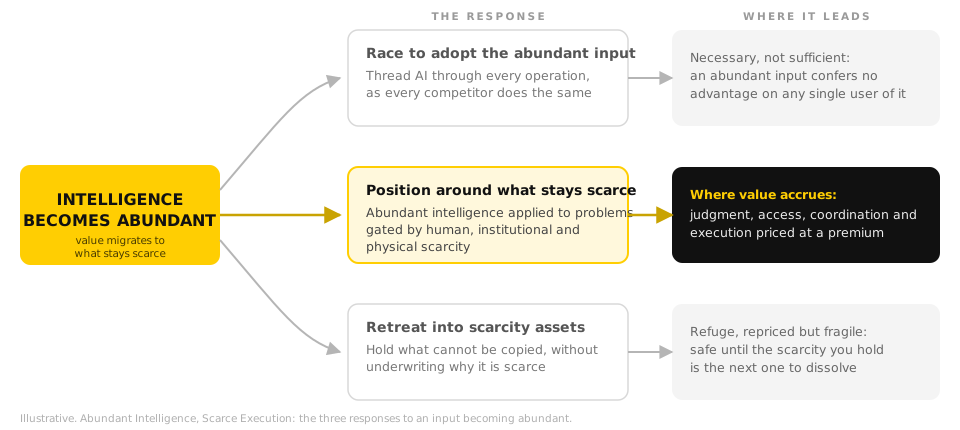
Some are racing to adopt the abundant thing, trying to assess how AI can be implemented through every aspect of their operation. This is necessary, and yet, it is not sufficient, because their competitors are renting the same intelligence at the same price. An abundant input gives no advantage to any single user of it.
Some are positioning around what stays scarce, and where we actually focus at 1200vc: the science that still needs a decade of implementation, the plant that still needs a permit, the relationship that still needs to be built. The most interesting version of this sits in the technologies where intelligence has just cut the cost of discovery by 100x while the deployment problem remains fully intact. Quantum, biotech, advanced manufacturing, energy, physical AI,... This is where the mental model says value accrues, because it is where abundant intelligence meets human, institutional and physical scarcity all at once.
And some are simply moving their capital into scarcity assets and hoping the storm passes somewhere else.
3. Intention or refuge
The 2nd path is what we do with our DeepTech investments and cross-border connectivity work at 1200vc, and the 1st is simply obvious. The 3rd path deserves a closer look, because two portfolios can hold the same assets and be opposites.
Holding scarce things deliberately, because you understand they are the complement of abundant intelligence and you can explain the mechanism repricing them, is the model working.
Holding the same things defensively, as shelter from a change you have declined to understand, is the model ignored.
The difference eventually shows: the one who makes a delivered choice knows which scarcities are durable and which are one robotics generation away from dissolving. The one that makes the choice out of finding a refuge, finds out when repricing eventually comes. So, scarcity is not a place to hide, it is a thing to underwrite for and strategize around. Wanting to act based on such understanding and not as mere negligence or laziness, is one's choice.
4. The questions that survive
In my own work, the model turns into a short list of questions that cheap intelligence cannot answer for me:
What should exist?
Who should be involved?
Which businesses should we own?
What standard should they operate at?
How should they be positioned?
Where should capital flow?
Who should trust us, and why?
Notice something about that list, almost every question carries the word should, and a should always points at a standard: some idea of what good looks like, held by someone. When competent answers were scarce, the standard could stay implicit, because producing any answer at all was the hard part. Now that anyone can generate a hundred competent answers in a minute, the standard becomes the scarce thing: Taste is knowing the standard before consensus forms around it. Contextualization is knowing which standard applies here, in this market, with these people. Assessment is being trusted to hold the standard when holding it costs something. The quietest form of the new scarcity may be exactly this: not the answers, but the standards the answers are measured against, and the people trusted to hold them. And just as elegance, not mere presence, shows in someone, so do standards - the difference being carried intentionality and care, in nature and grace.
So when I sit with a decision now, I ask what it actually depends on, and which of those dependencies anyone can rent. If the advantage I think I have lives on the rentable side, it is not an advantage, or at least not for a long time.
5. Where the model fails
I distrust any model I cannot break, so here is where this one breaks.
Intelligence is not abundant everywhere. Tacit knowledge, proprietary context, contextualized data, and the judgment that only comes from living with consequences, all those resist the commodity curve. In some rooms the scarce thing is still, in fact, intelligence, and applying this model there will make you wrong.
Execution is next in line. Physical AI is starting to do to implementation what language models did to analysis. Another example about how scarcity itself does not sit still, it migrates. Whoever applies this model once and files it away will wake up holding yesterday's scarcity.
And the model can curdle into scarcity worship. Read carelessly, and it justifies buying anything rare and calling it strategy. Rarity without demand is just illiquidity. So the model prices the complements of abundance, not scarcity for its own sake.
6. The old ideas underneath
None of this is new, which is exactly why I trust it.
Herbert Simon saw the shape of it in 1971: a wealth of information creates a poverty of attention. 50 years later I would push his line one step further and state that the wealth of information has also made information itself nearly worthless, so the premium has moved past attention to something more deliberate: educated attention, and intention about what deserves it.
Eliyahu Goldratt taught factory managers that a system produces only as fast as its bottleneck allows. The bottleneck of value creation has moved from thinking to doing.
Economists have long known that when one good becomes free, the money moves to its neighbor, to whatever must be combined with it. Intelligence is the good becoming free, so everything on the scarcity lists above is the next door.
And Aristotle got to the heart of it first. He separated episteme (knowledge of how things are) from phronesis (the practical wisdom of what to do): here, now, with these people and these constraints. Machines now produce episteme on demand. Phronesis they do not.
Abundant intelligence, scarce execution. An old rule with a new input. The people and institutions who understand this early will look very smart ten years from now, when really they just understood where value was shifting.
I write from a seat that looks at frontier technologies daily: new materials, energy storage, biotechnology, industrial automation, water, advanced manufacturing. As I think about the final deployments from our Fund I, reflect on the learnings from allocating into DeepTech since 2024, and I look towards our new Fund II, I realize that the science arriving to our eyes has never been stronger, and the question attached to it has never changed less: how, exactly, does this get deployed, why should it get deployed, and what are the impacts that these technologies will create. And none of that would be able to happen without the relationships we’ve been cultivating all along, or the numerous experiences I have from working across China, Africa, Europe, United States and Latin America as both a builder and an investor.
Paul Clastre
Summer 2026
Disclaimer: Text written by human, research supported by AI, cover image generated by AI.

