Convergence: The loop got faster

Jose Miguel Cortes
COO, Managing Partner
10
min read

It has been a few years since we launched the 1200vc strategy, and I have never been more certain of our direction than I am today. Reflecting on our journey ahead of our upcoming summit, I want to introduce this year’s central theme: Technology Convergence.
Our previous two summits explored The Americas Opportunity and The Frontiers of Change. This year’s focus ties those threads together, pinning down where we believe the most radical transformations will originate.
If you read my previous piece, you know I like to use analogies. I spent that entire first piece mapping 70 years of tech history onto the arc of human progress. It will come as no surprise that I also like to distill complex ideas into simple equations (so bear with me through 3 of them). Both analogies and formulas are how I unpack and internalize the world around me.
This reflection begins with a line I wrote at the end of that last piece: “what strikes me most about our current era is how fast progress arrives, so fast that many people have lost their capacity for amazement.”
I have been dwelling on that line ever since. The more I examine it, the more I realize that speed isn't just a byproduct of our era. It is the era.
None of this is new to write about. Plenty of people have, and some of them very well. The idea that technologies are converging, that change keeps arriving faster, even the broader theories about a singularity, has been discussed for years. What I want to do here is simplify it, into three small formulas, and add one point I think often gets lost: speed is not just making convergence faster, it is what makes it convergence at all.
We often say "everything is connected," but there are actually three distinct ways this manifests, and we tend to lump them together. Separating them is critical to understanding why this precise moment in time matters.
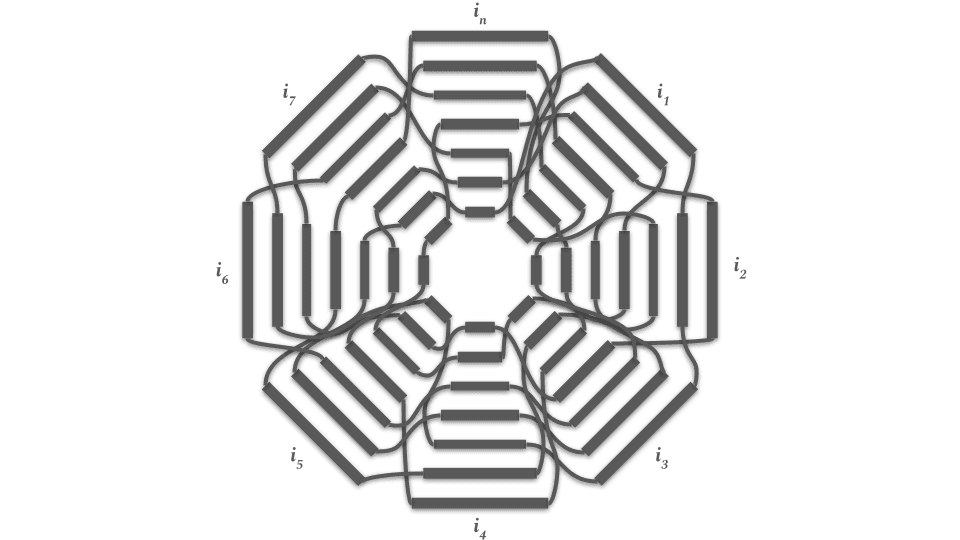
To lay this out as simply as possible, let “i” stand for industry and “t” stand for technology.
Interdependence: the basic system (+)
Every industry is tied to every other one. When one supplier fails, the line it feeds does not slow down, it stops. What one company spends is what another company earns, and a problem in one corner of the economy travels along these ties to every other corner. Each industry rises and falls with the ones around it: a good year for one lifts its suppliers, a bad one drags them down. So the first formula shows the economy as the sum of those parts:
Id = i₁ + i₂ + … + iₙ
Take a simple chain, minerals, batteries, cars, charging, the power grid, where each one sells to the next. Now take technology out of the picture. The system is still there. That is the limit of this view: it treats technology as just one more node in the sum, sitting next to the others. And that is the assumption that breaks first.
Transversality: technology inside everything (×)
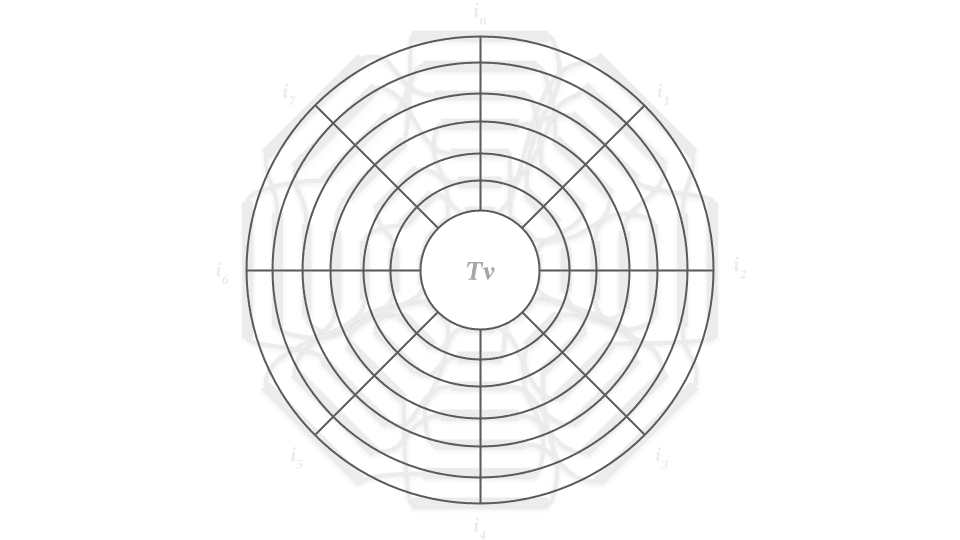
Technology is not only an industry in the system. By definition, technology is the “practical application of scientific knowledge, tools, and methods to solve problems and achieve human goals”. So it runs through everything. That is what the word transversal means here: it cuts across industries and/or business functions instead of sitting beside them. It does not get added to the economy as one more term. It multiplies the whole sum. No wonder tech has had the highest growth, has become the largest industry by market cap, and created the greatest fortunes in the past decades. Multiplication here means productivity, every extra dollar of revenue, or dollar saved on cost, raises the value of t.
Tv = t · (i₁ + i₂ + … + iₙ) = ti₁ + ti₂ + … + tiₙ
The second half of that line is the whole idea. When you multiply the sum by t, the t lands inside every industry: ti₁, ti₂, and so on. Technology shows up in all of them at once. And inside a single company it does not touch just one line of the accounts.
Take the Energy sector: from top-line expansion to bottom-line optimization, technology manifests as advanced storage solutions, next-generation grid networks, predictive equipment maintenance, automated demand forecasting, and far sharper risk evaluation.
Or look at Banking: tailored financial products, intelligent digital wallets, automated loan underwriting, streamlined back-office operations, and instant risk modeling. This same pattern unfolds across every single industry.
But this transversality is not necessarily new, either. Prior technological advances showed us that. Steam did it. Electricity did it. And of course the internet did it. Each one was a single big technology that spread into every industry, top to bottom, over many years. Not long ago we were still inside one of those waves, the mobile internet, reaching one industry at a time, and a common way to win was to copy a model that already worked somewhere else and bring it to a new market. That worked because the wave was slow enough to copy. If today were only artificial intelligence arriving as the next such wave, it would be very big, but it would not be a new kind of moment. It would be the same show with a new lead actor.
It is not that. The reason is the third formula.
Convergence: the old loop, times speed (^)
Convergence means technologies improve each other:
Artificial intelligence helps find new materials —> better materials make better chips and cheaper energy —> cheaper energy allows more computing —> more computing improves the models, and the circle keeps going.
Instead of one technology at a time, you get several feeding one another. The formula has two parts:
Cv = (t₁ · t₂ · … · tn)L · S
The product of the technologies represents their mutual reinforcement. Raising that product to the power of L (the number of feedback loops between them) captures something important: the more loops that connect these technologies, the more powerfully they amplify each other.
The first part, technologies multiplying and building on each other, is not new. It has been happening for a very long time. Steam, coal, iron and the railway pushed each other forward for a century:
Steam engines pumped water out of coal mines, which gave us more coal to smelt cheaper iron, which built better engines and more rail.
Machine tools have always been used to build better machine tools, each generation a little more precise than the last.
And for the last fifty years, chips have been used to design the chips that come after them, so every new generation helps create the next.
The pattern is old and familiar: progress in one field pushes progress in another, and it has quietly driven steady gains across every sector for centuries.
What is new is the last term: S, for speed. Multiply that old loop by a high enough speed and it changes in kind, not just in size. Take S away and you are back to the slow, familiar loop that has run for centuries. That is why I put speed outside the parentheses. It is the part that makes convergence actually exist.
Here is the point I most want to be clear about. Speed does not only make the loop faster. Speed is what turns it into convergence at all:
When the loop is slow, it is just steady progress: one field hands something to the next, you have years to take it in, and it feels calm and normal.
Speed it up enough and the fields stop being separate. What comes out of one becomes the input to the next before you have even finished reading about the first. Materials, computing and biology stop being different rooms and become one moving thing.
Slow, it is a relay race. Fast, it is a single reaction.
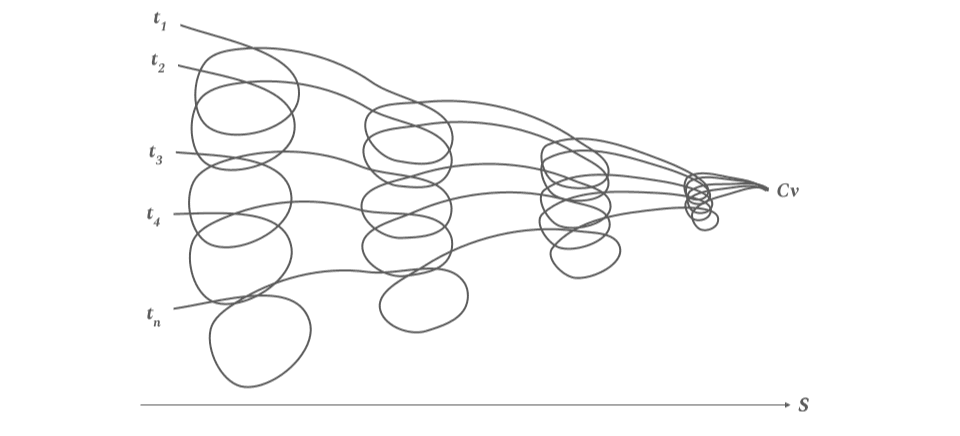
So the question to ask is not which technology, but how fast the loop closes. And it is closing much faster than before. What used to take a generation now takes a year, sometimes months. A protein shape that once took a lab years to work out can now be predicted in seconds. Several of these loops are running at the same time, and artificial intelligence sits inside all of them, speeding up not only its own work but the making of new tools.
This is why speed changes everything. Fast growth fools the eye. While it is slow, it looks like a straight line, and you keep up with no trouble. It only takes over when it moves faster than you can react. That is what is happening now.
Why you have to watch all of it
If both the gains and the threats come from where technologies meet, then watching only one side leaves you blind. Most people follow a single field, so no one is really looking at the space between fields, which is exactly where the new thing forms. You will not see a new battery built from artificial intelligence, materials, and energy if you only follow AI, or only energy: it is born in the overlap, and belongs to none of them alone. The same is true elsewhere, real estate reshaped by biology through engineered, living building materials, or logistics reshaped by quantum computing through routing problems no ordinary computer can solve. I will leave those there for now, but the examples are everywhere: different technologies colliding to create new things, faster and better than either could alone.
This is why I argue for looking widely rather than deeply at one thing. Artificial intelligence, hardware, quantum, biology, materials, these are not a menu to pick one from. Together they are how you notice where things are moving. Leaving one out is not discipline; it is a blind spot placed exactly where the next surprise will come from. It is also why a clear map of the whole field, one that holds every technology and every industry in a single view, is worth more than a longer list of names. A map like that lets you see a meeting point as a meeting point, instead of missing it because two people each watch half of it.
It is a hedge, not only a bet
Watching these trends is not just about upside, finding early winners, it is also essential risk management. You cannot prepare for a shortage or defend against a threat you never saw coming.
Today, major business disruptions usually originate from neighbouring fields rather than direct rivals. Companies focused narrowly on their own industry are often caught by surprise because key developments occur outside their view. As feedback loops accelerate, response times shrink to a single planning cycle or less.
Monitoring core technologies is therefore a defensive necessity before it is a strategy. The same speed that creates opportunity sharpens risk, and a broad view is your best defense.
Wherever you sit
While I write from a venture perspective, the impact of accelerating feedback loops applies regardless of your role:
For professionals: Align your skill set with these shifts so you stay ahead of automation rather than defending obsolete capabilities.
For business leaders: Identify which cross-industry technology loops will disrupt your business first, your next competitor will likely emerge from outside your industry.
For investors: Price assets based on dynamic technological velocity rather than static historical performance.
For allocators: Index exposure or late-stage tech investments might capture gains but fail to manage risk; monitoring early-stage innovation is critical to anticipating broader portfolio disruption.
To be clear, looking widely does not mean investing blindly. There is a sharp distinction between scanning the horizon to spot where technologies converge and actually deploying capital. Wide vision informs the map; narrow execution protects the capital. This isn't a distant forecast, it requires acting on the shifts already underway.
Conclusion and caveats
So here is the whole thing in three short formulas. I am not trying to propose formal academic equations or pretend to offer new math here; this is simply a “math-like” visualization exercise, a conceptual shorthand to help us observe the distinct dimensions and mechanics of our current era. The economy has always been an interdependent sum of industries (Id), while past technology waves multiplied productivity across them (Tv). Today’s shift is unique because accelerating speed (S) compounds these overlapping feedback loops (Cv), further amplified by emerging capabilities like quantum simulation.
We are the first generation navigating this real-time, exponential acceleration as it happens.
However, this speed is not guaranteed. A loop only runs as fast as its slowest part allows, and any number of things can become that limit: physical constraints on what materials or machines can do, shortages of energy to power it all, regulation that slows what can be deployed, or a loss of public trust that makes people reject the technology altogether. Any one of these could stall the loops, or at least hold them back for a while. That question, what could slow convergence down, matters as much as the speed itself, and it may well deserve a full piece of its own, which we will likely write soon. For now, convergence remains the defining trend, but it is one we should watch closely rather than take for granted.
Jose Miguel Cortés
18 September 2026
_____________________
Disclaimer. These are my own views, shared for general information only. Not investment, legal, or tax advice, and not an offer or solicitation to buy or sell any security or fund interest. It includes forward-looking opinions that may not pan out, so please do your own research and talk to your own advisors before making any investment or business decision.
Sources
S&P Dow Jones Indices — S&P 500 Information Technology sector (largest sector by market weight). spglobal.com/spdji
Forbes World's Billionaires List, 2026 — billionaire wealth by industry (Technology largest). forbes.com
DeepMind, AlphaFold2 — CASP14 (2020); Jumper et al., Nature (2021); 2024 Nobel Prize in Chemistry. deepmind.google

